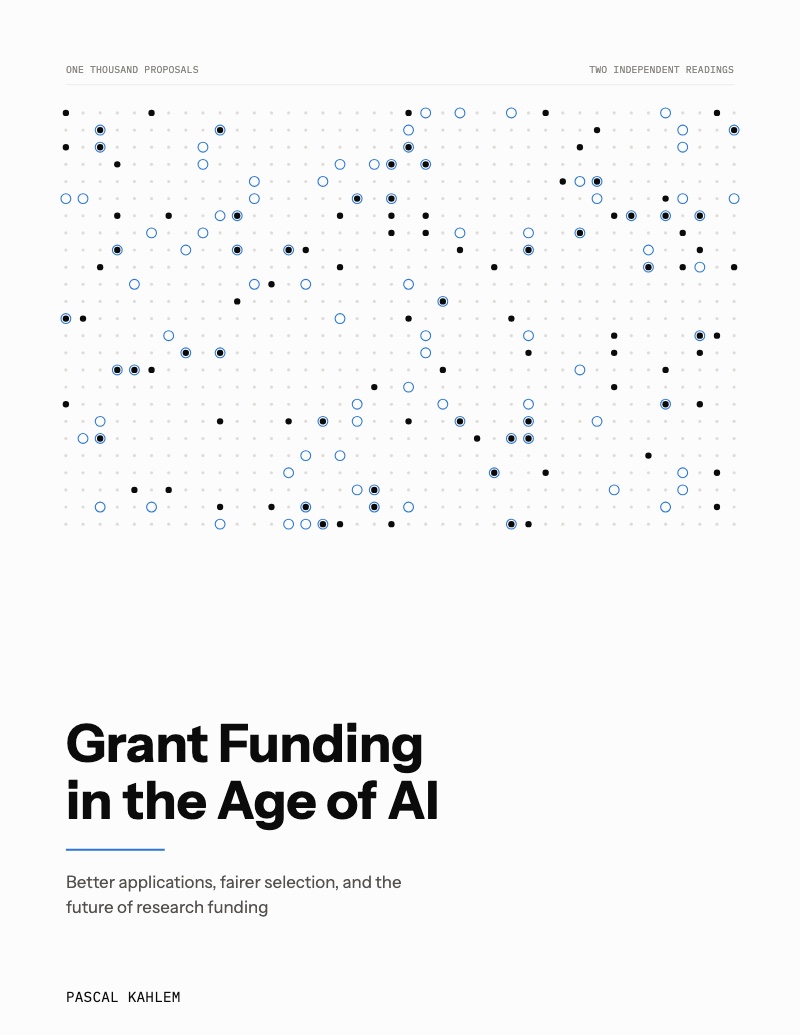
This third book is not a guide to writing proposals. The first two are. This one asks what happens on the other side of the desk. Funders spent decades building systems that sort a limited number of applications, and those systems assumed that writing a strong proposal was slow, hard and expensive. That assumption no longer holds.
It answers from the funders’ own documents. A register records what twelve funders actually require, each entry a reading of one named document on one dated day, so that a reader can check it rather than take it on trust. Several of those positions changed during 2026, and the book says which.
Thirty-seven original figures carry the argument. Each one joins at least two sources or applies an analysis its sources do not perform. The scripts that draw every figure are deposited openly, so any figure can be checked against its sources without trusting the author.
Four of its conclusions run against the commercial interest of the person who wrote it. Chapter 13 concludes that one common form of paid review sells cheap checks at an expensive price. Chapter 15 sets out confidentiality obligations that this trade mostly does not meet. Chapter 16 says that the services easiest to charge for are the ones worth least. Chapter 17 concludes that no consultancy has the sample size to support its own win rate, and says plainly that SNM is included in that.
The book names no client, no client project and no coordinator. Tests of SNM’s own software stay out of it: no evaluation of that software exists to the standard the book sets for evidence, so none is reported.
Buy the paperback on Amazon (opens in a new tab)The figure supplement, free on Zenodo (opens in a new tab)